
What digital Scripture engagement analytics is teaching us about reach, depth, and discipleship.
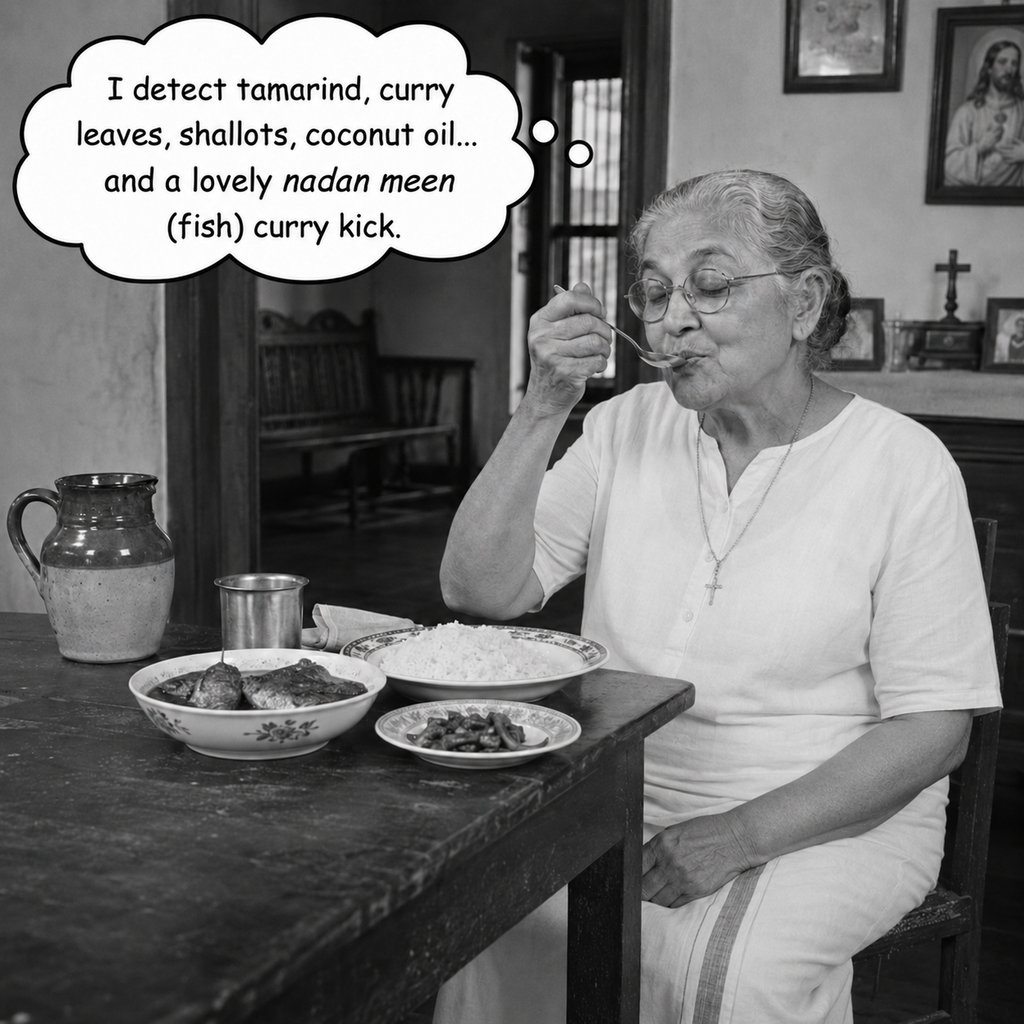
She sat at the head of the table, lifted a single spoonful of fish curry to her lips, and closed her eyes. A pause. Then the verdict: tamarind, curry leaves, shallots, a touch of coconut oil, and just the right kick of a good nadan meen curry. She was almost never wrong.
My grandmother never owned a computer. She never opened a dashboard. But she was, without question, the first data analyst I ever met. She observed carefully. She identified the inputs. And she never, ever underestimated the feedback. She did not call any of this analysis. She simply paid attention.
Years later, working in digital mission, I realised she had handed me the whole discipline in a single spoonful. Because that is what data analysis really is: careful thinking about evidence, so that we can make better decisions. The tools have changed. The instinct has not.
01 From “should we?” to “how well?”
For years, the mission conversation circled one question: should we go digital? That debate is over. After the pandemic accelerated everything, the question has changed. It is no longer whether we should go digital, but how effectively we are actually engaging.
And digital Scripture engagement is more than broadcasting content or watching download numbers climb. It is people encountering God’s Word in ways that can genuinely transform their lives – through phones, apps, audio, video, and online communities. For the oral communities we serve across Asia and beyond, that means leading with audio Bibles and Gospel films in the heart language, not only text. It means understanding how a community actually uses technology. And it means connecting people not merely to information, but to God himself, and to one another, for deeper discipleship.
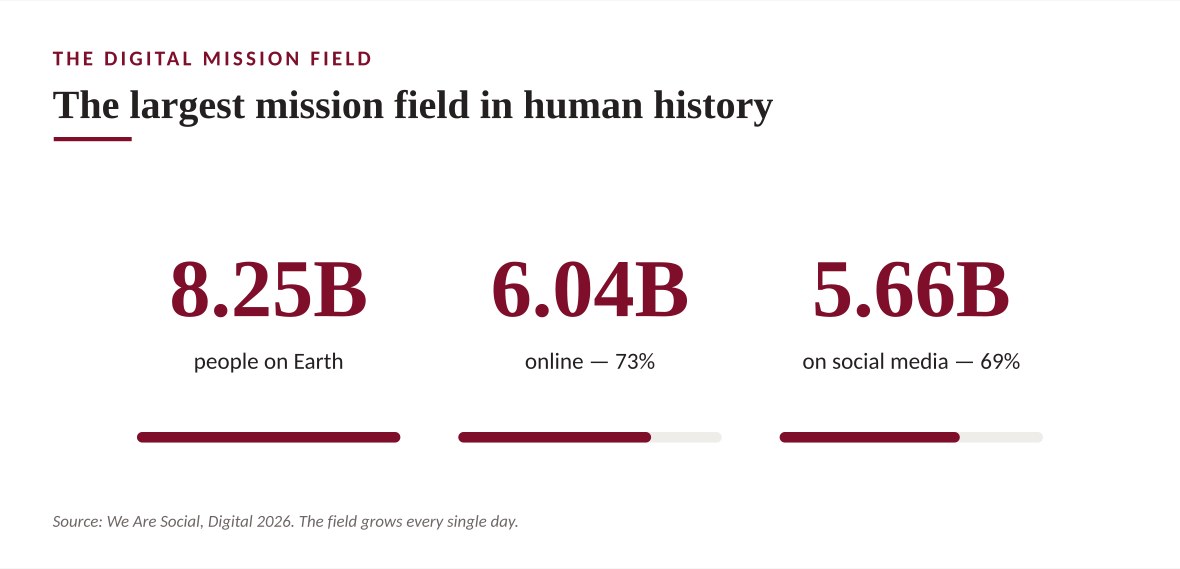
The scale is staggering. The Digital 2026 report puts the world at 8.25 billion people, with more than 6 billion online and 5.66 billion holding a social media identity. The Church has always travelled the roads of its era – Roman roads, then radio waves. Today those roads run through WhatsApp, YouTube Shorts, Facebook Reels, TikTok, and Bible apps, with AI, virtual reality, and augmented reality beginning to shape how people experience the biblical story.
02 Reach is not the same as response
For a long time, data lived with tech teams, analysts, and donor reports. That has changed. Today it is a practical, everyday tool for front line decisions – whether you coordinate a field, manage a language program, produce media, or facilitate a church network. You do not need to be a data scientist. You need to be a faithful steward who is willing to look, listen, and adjust.
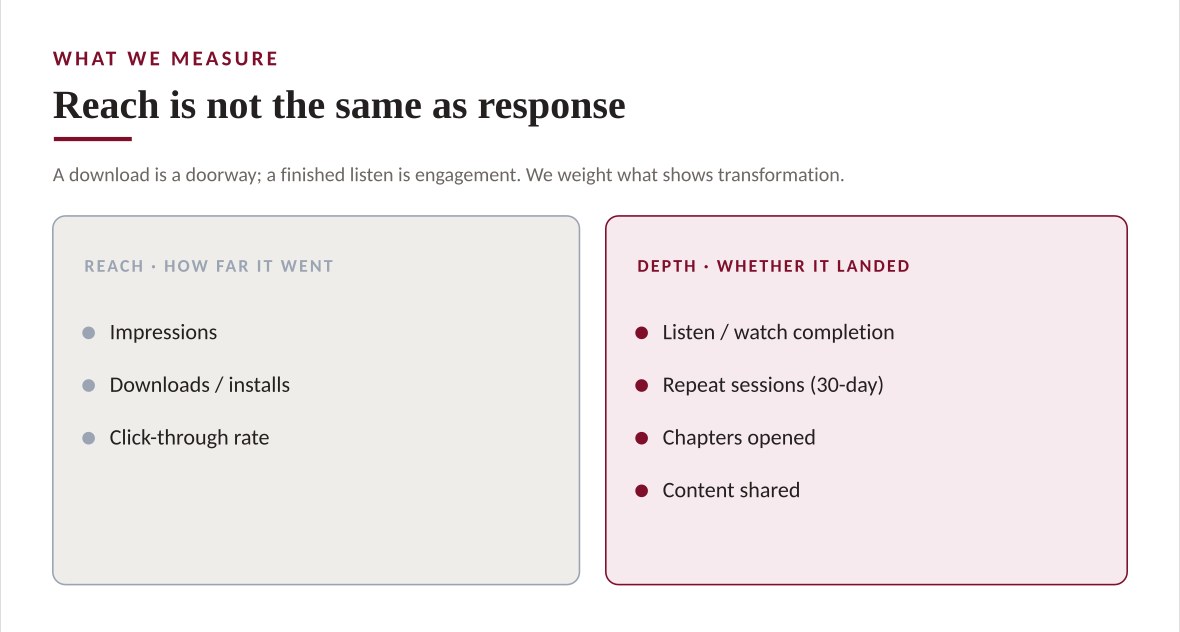
Here is where the discipline earns its keep. Reach alone can fool us. A film can be shared widely and still connect with no one. So we look deeper – at completion rates, repeat sessions, chapters opened, content shared. A download is only a doorway; a finished listen, and a return the next night, is engagement. When people in a diaspora community watch a long-form film in their language all the way to the end, the data is telling us something a download count never could.
Consider a small, concrete example. We run advertising to drive Bible app installs. But we never stop at the install. We ask whether people are actually listening to the audio Bible and opening new chapters. And the data shapes the work itself: we refine where we advertise using heart-language data from sources like Joshua Project and Ethnologue, so our outreach reaches the right language communities in the places those languages are actually spoken. The data does not just measure the campaign. It keeps improving it.
03 A simple loop, used prayerfully
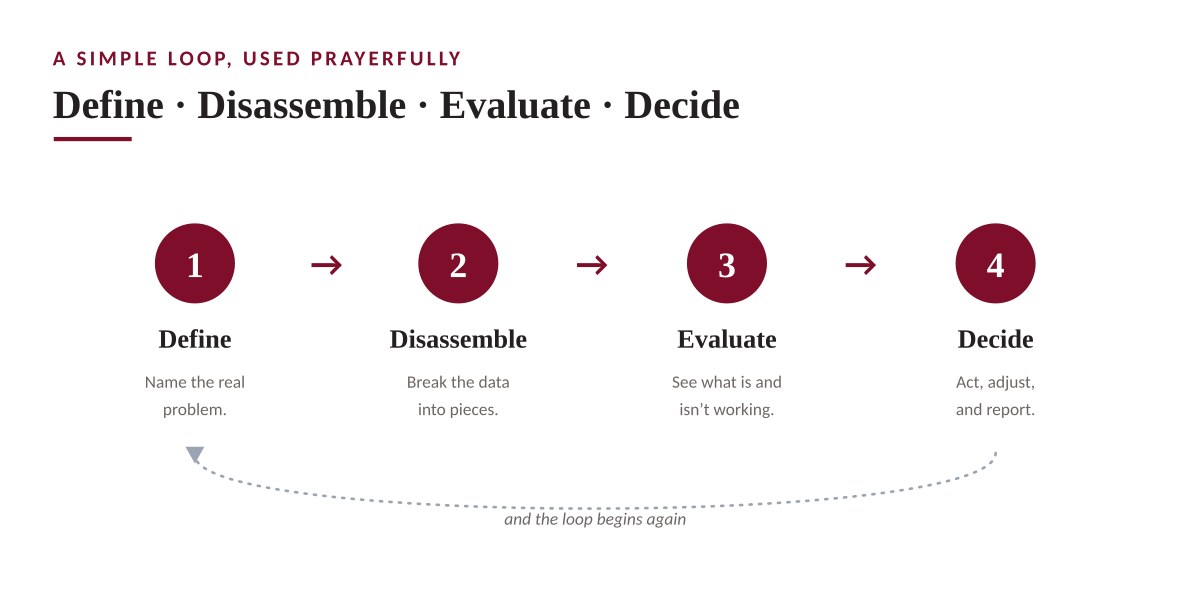
To make sense of all the information, we use a simple four-step loop. We Define the problem. We Disassemble the data into smaller pieces. We Evaluate what those pieces are telling us. Then we Decide, and act. When a campaign promoting an audio Bible under performs, the loop tells us whether the gap is in the content, the audience, or the platform – and whether to adjust the targeting, revise the creative, or move elsewhere. It is not academic. It helps teams make smarter, faster, more prayerful decisions. And it keeps us humble, because the data often shows us when our assumptions were wrong.
04 A signal from the Gulf
Let me tell you the story that captures all of this. It comes from one of our teams in Africa.
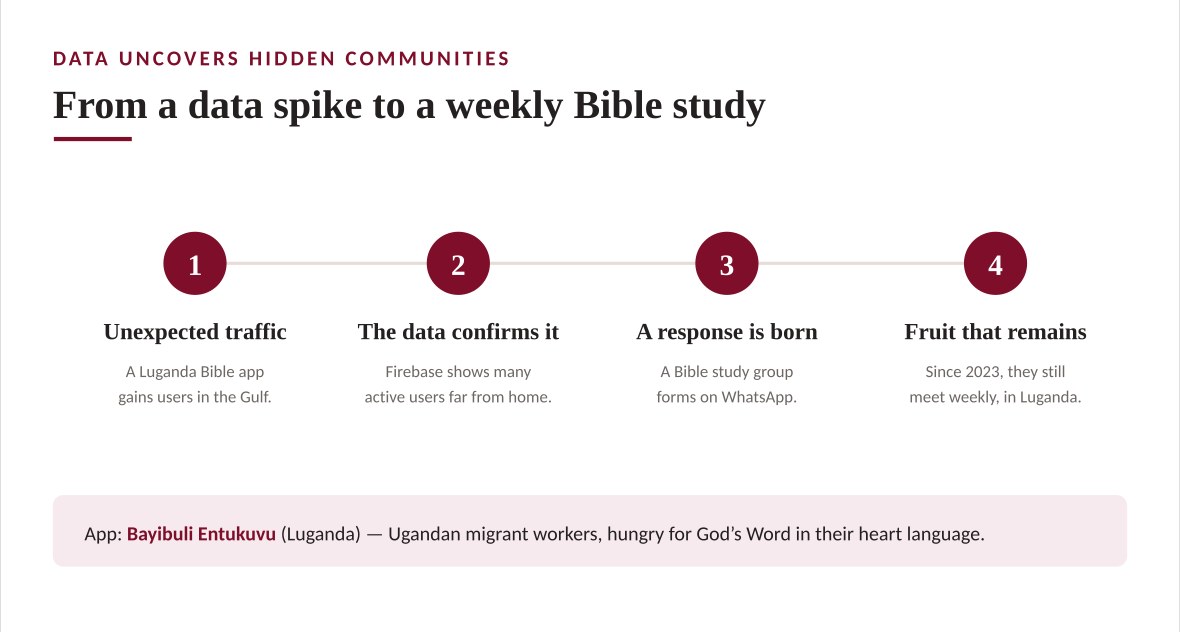
The team had built a Bible app for Uganda called Bayibuli Entukuvu – the Holy Bible, in Luganda. Then something strange happened. The app began gaining real traction far from home, in the Middle East. Messages started arriving from Saudi Arabia, the UAE, Qatar, and beyond. At first the team wondered if it was simply spam. But they were curious, so they looked closer.
They opened their Firebase usage data, and there it was: a significant share of their active users were in the Gulf. These were Ugandan migrant workers – far from home, and hungry for God’s Word in Luganda, their own heart language. That single insight changed everything. The team set up a Bible study group on WhatsApp. And here is the part I love most: from 2023 until today, those workers are still meeting every week, reading through the app and discussing together, all of it in Luganda.
Without the data, no one would have known these believers existed. The data did not replace ministry. It pointed ministry to where the Spirit was already at work.
This is what we mean when we say listening to the data is really listening to people. The numbers opened a door that no one knew was there. (The app, Bayibuli Entukuvu, is freely available on Google Play.)
05 Listening well, and within limits
Stories like that one are only possible when the listening is done well, and done responsibly. Our pipeline is simple: we collect from our apps, websites, and social platforms; we clean and standardise; we store it where it can be compared; we visualise it; and then we decide, and the loop begins again. Tools like Google Analytics, Firebase, FCBH Analytics, and Bible Brain – which offers free access to Scripture in more than 2,500 languages – are our listening posts across the digital field.
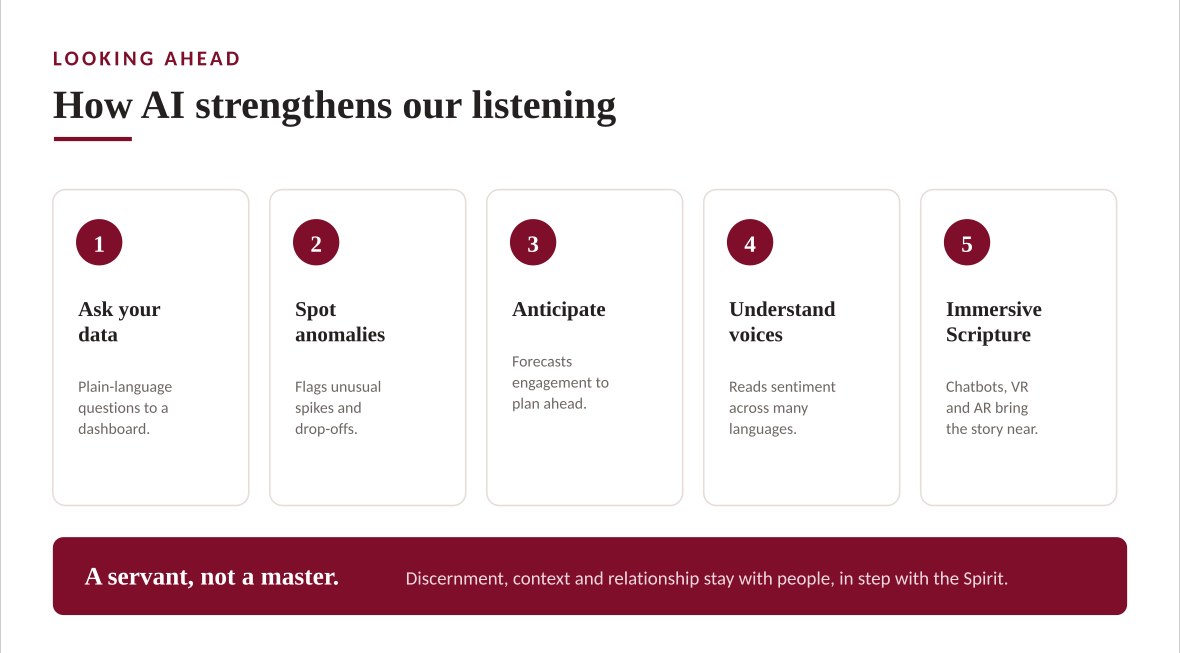
Artificial intelligence is quietly expanding what is possible. It lets a field worker ask a dashboard a question in plain language. It flags unusual spikes and drop-offs, so a pattern like that Gulf surge surfaces in days rather than months. It can forecast engagement, read sentiment across many languages, and open immersive new ways to experience the biblical story. But we hold it carefully: AI is a powerful servant and a poor master. It speeds up our listening, yet discernment, context, and genuine relationship still belong to people, in step with the Spirit.
And because this data describes real people, the principles matter as much as the methods. We work in the spirit of the wider community of mission information workers, where data, research, knowledge, and wisdom all serve Christian mission, and where every one of us is still a learner. In practice that means a few firm commitments. We treat every metric as a proxy for a genuine condition of Scripture engagement – availability, the heart language, spiritual hunger, the freedom to respond – never as a vanity number. We aggregate and anonymize, and in sensitive regions we collect the minimum, because the safety and dignity of a person always outranks the richness of a dataset. And we report honestly, so that partners and supporters see real outcomes rather than inflated claims. Good data is, in the end, good stewardship.
06 Questions we are often asked
Aren’t these just vanity metrics?
Only if we let them be. We anchor on depth, not reach. A download tells us something traveled; completion, repeat use, and sharing tell us it connected. We never report reach on its own.
How do you protect people, especially in closed countries?
All our analytics are aggregated and anonymized – we look at patterns, never identifiable individuals. In sensitive regions we collect as little as possible and favor private, secure channels. Protecting a person always comes before the data.
We are a small team with almost no budget. Where do we start?
Start free and simple. Pick one or two depth metrics, such as completion and repeat use, and one real question you want answered. You do not need a data scientist. You need the habit of paying attention.
Isn’t this just reducing ministry to numbers?
That is the danger, and naming it keeps us honest. The moment data becomes about watching numbers instead of caring for people, we have lost the plot. For us the data is a window into people’s lives – it shows where someone may be drifting, or where a group needs encouragement. We are not surveilling numbers. We are trying to tend souls.
07 In the end, it is not about numbers
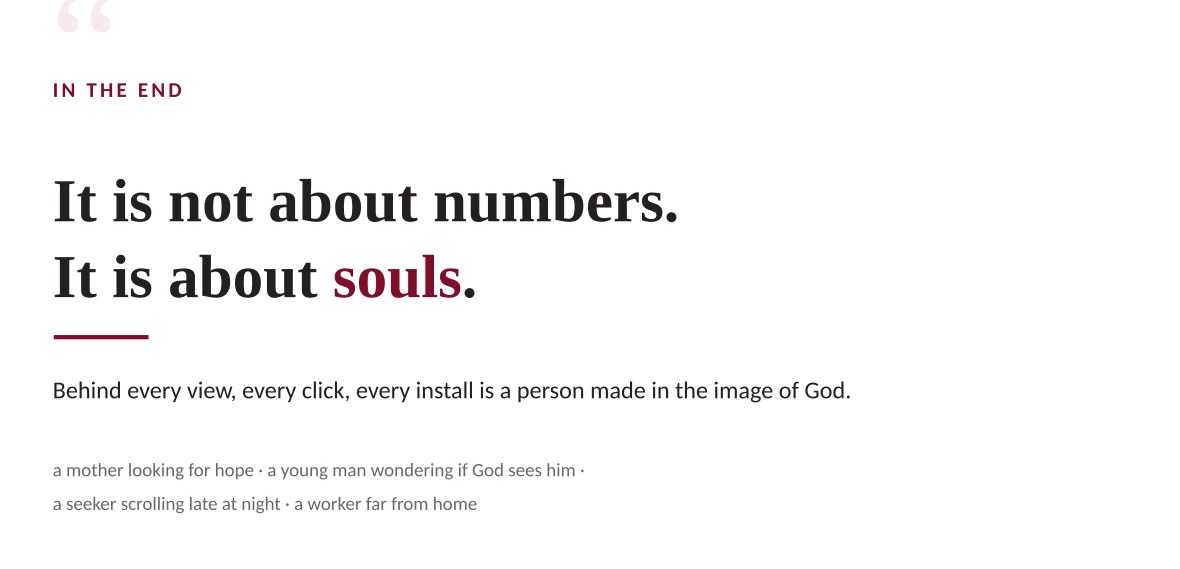
Behind every view, every click, and every app install is a person made in the image of God. A mother looking for hope. A young man wondering whether God sees him. A worker far from home, holding on to the only Word he can understand. Yes, we track reach and engagement. But ultimately we are praying for encounters.
My grandmother taught me to pay attention – to taste carefully, to notice what is really there, and to respond. The data simply lets us pay that kind of attention at scale, and then move toward people with love. So we will keep planting the Word faithfully, watching for fruit, and adjusting our course with wisdom and grace. Because when Scripture is shared well, and we listen to what the data is telling us, lives are changed.
Data is not the finish line. It is a feedback loop – one that leads to deeper Scripture engagement, and deeper love for the people behind every number.
Go deeper
Explore a Scripture app in the heart language: Bayibuli Entukuvu (Luganda) on Google Play.
Learn more about audio and video Scripture, and Bibles in more than 2,500 languages, through Faith Comes By Hearing and Bible Brain.
This article grows out of a session shared at the Mission Information Workers’ Virtual Conference 2026. Personal names in the field story have been withheld out of respect for the team and the community involved. The opening image is an AI-generated, photo-style picture created in honour of a much-loved grandmother whose photograph we do not have.