

Not surprisingly AI featured a lot at EMDC2026. I attended the Advanced AI track at post EMDC which used material also available at https://center.sabda.org/ combined with some hands on experience carrying out tasks within a virtual computer (faster than most of our own laptops).
Specifically we used AI to transcribe videos, turned text into speech, and explored the many possibilities of Google’s NotebookLM.
All these were components of a project to transcribe 800+ videos from the archives of EMDC.academy and sessions at live EMDC event and turn them into “EMDC GPT”. In some ways I’d love to see it do the same for mining the wisdom of the SIL archives and libraries and archives of other agencies involved. It might need careful prompting and discernment to know how to make use of such rich resources. I remember standing in a fairly small library while doing an MA in missiology and recognising that every inch of every shelf could represent years of work. I read a lot and spent a lot of time reflecting on what I read. AI can look through thousands of books and glean information that might of value. The balance is in in ensuring that it is used as a research assistant not a researcher replacement.
There have been many developments in AI even since ChatGPT was publicly released as the Chatbot on top of Open AI’s “Large Language Model”, back in Nov 2022 but Bible translation organisations have been using computers to assist work for decades. Few people will remember the “Linguistic Information Retrieval Project” which aimed “to enable you to maximize the amount of time you spend in thinking, by minimizing for you the time you spend acting as your own slave.”
This was a project from 1963 when Joe Grimes stated, “Your time is worth a lot. You can use it up in routine labor like the work of filling out file slips and alphabetizing them – remembering that the Romans would have bought slaves to do that kind of thing. Or you can invest your time where it counts most: in extending your total experience in the language and culture by getting away from your desk and talking with people, or else in thinking creatively about the systems that underlie the language.”
It would perhaps be good if we thought of today’s AI this way, as a tool that allows space for human interaction and creative thought.
AI can vastly speed up a huge number of tasks and help not only in translation of Scripture but also in translating and repackaging many other resources that can aid people in engaging with scriptures. The EMDC advanced AI track explored many creative uses of AI in engaging with the Bible and also in providing far greater access to wider education, or even the use of AI in biblically based counselling. This latter idea might rightly ring a few alarm bells and should ideally never be a substitute for counselling by real, trained counsellors – but real, trained counsellors are simply not available to huge numbers of people, so is a risky imperfect solution better than no solution at all? I reflected that for over 50 years ago missionaries and others have had access to a book called “Where there is no doctor” – this remains a valuable resource and is now available in over 100 languages, but is not a substitute for where there is a doctor. AI could probably help translate much of it into the next 1000 languages, but it could be wise not to publish without careful review.
A key risk of AI is that it is incredibly good at sounding more intelligent than it actually is and lulling people into a false sense of confidence. The more plausible it sounds the less likely people are to check it.
Along with many other warnings that AI has dangers the course offered ways to reduce some of the risks with a focus on wise use of AI for God. Like many I have my concerns over this technology and how it will affect Bible Translation, Scripture Engagement, Language development and every other aspect of SIL’s work but as it says in one of the songs I created with the help of Gemini and Suno.com,
“AI can help the church if it doesn’t rot our brain,
You don’t have to worship the tracks, but you cannot stop the train!”
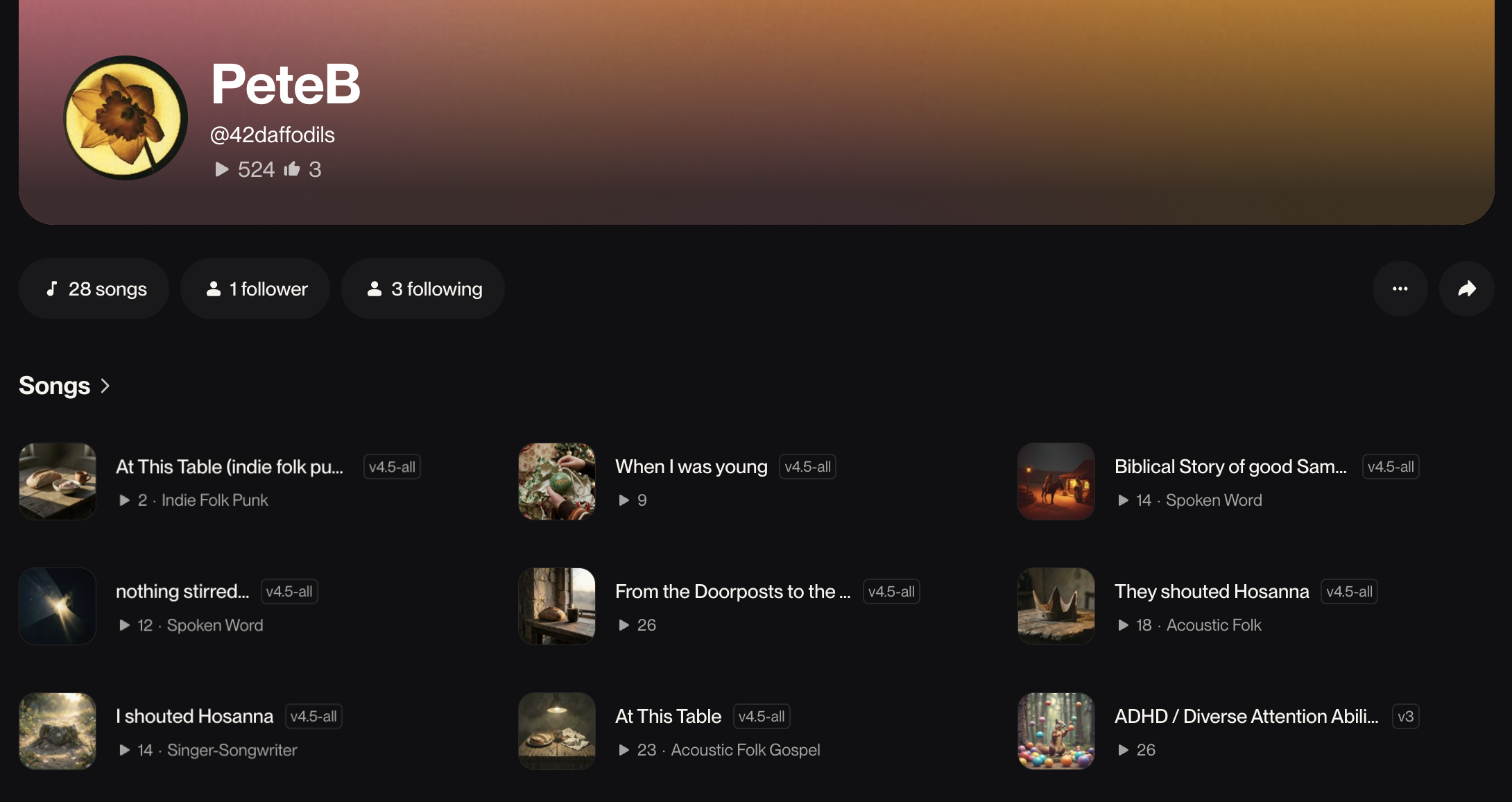
I’ll spare you that particular song but you can find others I’ve co-created at suno.com/@42daffodils. I have been impressed at how good some AI generated songs are, and how much others really do deserve the title of ‘AI slop’. Good songs can take careful prompting and curation, or sometimes just clicking the button and being surprised by the results. Lately I’ve been exploring getting Gemini to suggest how I prompt Suno to get a particular style or to adapt a poem I wrote 30 years ago into more of a sung piece.
Joe Grimes, who I mentioned earlier, was also a pioneer of possibly the first computer program to randomly generate short stories in minority languages (or possibly in any language). I suspect he would have been quick to try out what Suno can do, but AI generated lyric or tunes are accompanied by ethical issues over content creation as well as resistance from those that rightly point out that however good a mimic AI is, it doesn’t have a soul. More on that perhaps in a future post.
Since attending the course Pope Leo XIV has released his own thoughts on AI in an Encyclical letter, (many steps up from a humble blog post). Magnifica Humanitas, talks about ‘Safeguarding the Human Person in the Time of Artificial Intelligence’, and several commentators, Catholic, Protestant, and others of no religious belief have suggested reading the full letter rather than an AI summary of it.
Discussions on the benefits and risks of AI will continue, and if you ask AI about it you’ll get a mix of responses depending on how you prompt it. Fortunately there is good advice on prompting in the 2024 version of AI-4-God! Beginners which has been turned into an e-book, with the help of AI and the careful review of the humans steering the process.
That sounds like a really interesting session – it’s good to see practical applications being developed alongside discussion about ethical considerations.
Thanks much, if you want to have access to sessions like this one, you can register here… https://emdc.academy/home