
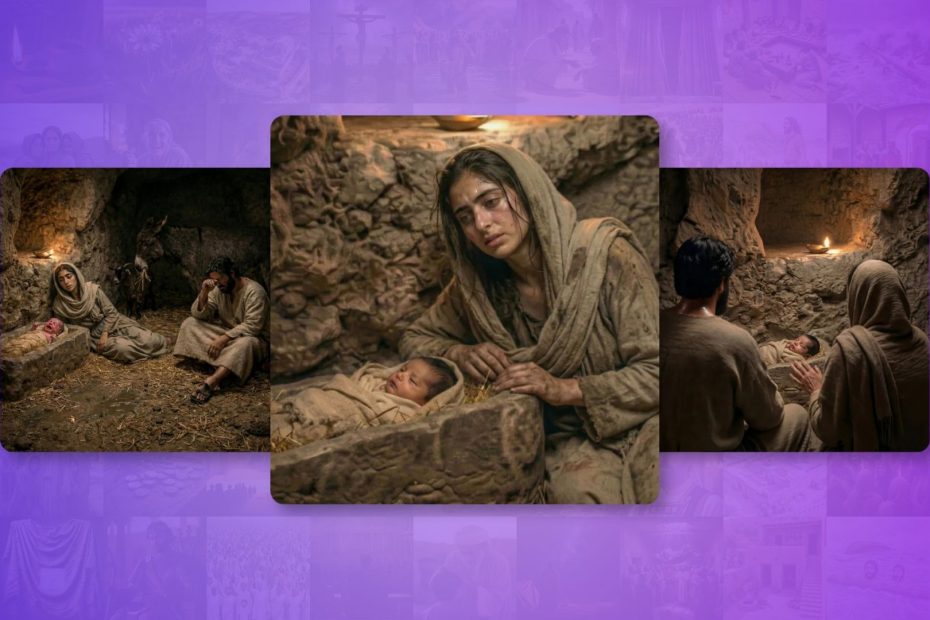
Efficiency is not the same as Faithfulness
AI can create biblical images in seconds. But speed does not equal faithfulness.
That was one of the main ideas that I (Johnny) shared during my EMDC breakout session, “Using AI to Visualize Scripture.” The session was not really about becoming better image prompt writers, although prompting matters. It was about helping Bible translators, teachers, Scripture engagement workers, artists, and ministry leaders slow down long enough to ask better questions before using AI-generated biblical imagery.
Because biblical images are never just decoration. They shape imagination. Imagination shapes memory. And memory shapes how people teach, worship, and understand Scripture.
For many people, especially visual and oral learners, the images they see become part of how they remember the Bible. That is powerful, but it also means our visual choices carry responsibility. Every detail we include teaches something. Every detail we leave out teaches something too.
Why this matters now
AI imagery is changing quickly. Not long ago, many people dismissed AI images because of obvious problems: strange hands, odd faces, visual glitches, or generic styles. Those problems have not completely disappeared yet, but the tools are improving rapidly.
That creates both opportunity and danger.
It is now easier than ever for a small team, church, school, or ministry to create images for Bible teaching and communication. But it is also easier than ever to create images that are beautiful, persuasive, and wrong.
The harder question is not only, “Can we make this image?” The better question is, “Should we make this image, should we use it, and can we trust it?”
Common misconceptions about AI biblical imagery
In the session, I named a few misconceptions I often hear when talking about AI Imagery. These misconceptions are often based on a core hint of truth, but it is worth reviewing and discussing these misconceptions and how we at Open Bible Images seek to address some of the underlying truth they uncover.
- AI is Low Quality. The early days of AI art was filled with bizarre images. Still today we sometimes get bizarre compositions and images. Sometimes, but not always. Like many other tools it depends on how they are used. This is one area where keeping up with the changing industry shows just how rapidly the improvements in quality have materialized and will continue to improve.
- AI is easy. It is true that is easier than ever to generate something. However It is still hard to generate something faithful and useful. Access does not replace the work needed to determine what to create in the first place.
- AI Images all Look the Same. I resonate with this complaint. Especially as you look at older models like Dalle-3. Yes, Default styles bias exist, but we don’t have to use defaults, and styles can be shaped with care, references, and review. So default images often do look the same, but they don’t have to.
- AI is Always Biased Wrong. Yes, there is bias in all models, and Raw output should not be blindly trusted. But careful workflows can help expose and correct assumptions and point the models to create with the right assumptions. The models are trained on misconceptions in popular media, but they are also trained on centuries of high quality Biblical study. You need to point the model in the right direction.
- AI Cannot keep things consistent. Here is another area that is rapidly developing in AI research. A couple years ago it was very difficult to get consistency in characters, scenes or objects, but consistency is becoming more possible with new models, reference images, trained workflows, and human oversight.
- AI is Cheap to Produce. AI is inexpensive to produce, but only to a point. New models can create workflows that dramatically improve efficiency, yet using AI effectively and faithfully still requires intentional human oversight—and human labor is not always cheap.
The future of biblical imagery should not be shaped by whoever can most quickly write a prompt. It should be shaped by Scripture, wisdom, historical care, cultural humility, and the global Church.
A nativity scene is not simple
One of the examples we discussed was the nativity.
At first, it feels like an easy image to make. Go ahead try it right now yourself. Just ask AI for “a nativity scene,” or “the birth of Jesus” and something beautiful will likely appear. But then the questions begin.
Should the setting look like a Western wooden stable, or a first-century Judean home with a lower animal area? Should there be animals? Shepherds? Magi? A glowing baby? A clean, peaceful room? A tired mother? Signs of poverty, danger, or overcrowding? What should Mary and Joseph look like? What assumptions are we importing from Christmas cards, children’s pageants, Renaissance paintings, or our own cultural imagination?
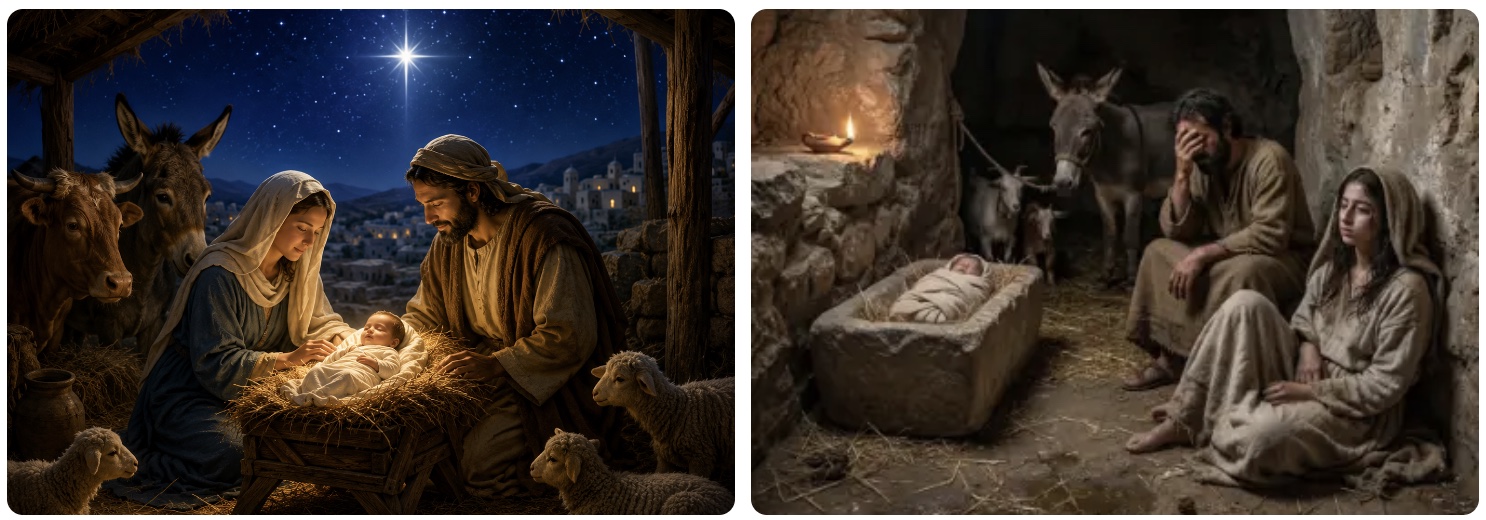
AI does not remove that interpretive responsibility. It accelerates it.
A simple workflow for wiser use
For ministries that want to use AI imagery responsibly, I shared the workflow we use at Open Bible Images that they could use to inform their creation workflows. The list is a bit long, but we value faithfulness and trust. We could cut several of these steps to speed up the process, but we want to make sure trustworthyness remains at the center of what we create at Open Bible Images:
- Start with Scripture. Start by reviewing and giving the Bible passage as well as any relevant context, you already know is important to an AI Agent. Tell the AI you want to be faithful to scripture and history.
- Define the purpose of the image. Why are you creating this image in the first point what is the purpose and what are you hoping to communicate through it? What do you not yet know about this passage? Again share this with the AI Agent, ask questions and build context.
- Research the context: Ask the AI to review the context of the passage and image. Have it research setting, people, clothing, objects, architecture, and emotion. If you’re not sure what to ask, ask AI to give you clarifying questions to help you focus the context.
- Generate an Image Prompt with clear constraints. Ask the AI to help you generate an image prompt. Read the prompt and refine it. Add constraints for common problems in AI imagery. Tell the AI what you want and do not want in an image. For example we often will ask for historical authenticity and to intentionally avoid western bias.
- Generate multiple drafts. Once you have a prompt ask the AI to generate the image, or else copy the prompt to your AI Imagery modeling tool of choice. Review the output. Don’t just stick with the first version even if you like the first one ask it to generate multiple images so you can start to get a sense of how the image could be seen in different ways. Pick the one you think is most faithful.
- Review for biblical, historical, cultural, and visual problems. Don’t trust yourself too much. Ask other people to give you feedback. Also give the image back to a new AI chat and ask it to review harshly and give critical feedback and help give prompts to refine and improve the image.
- Revise or reject. You’re not done yet, keep working. Use the input you’ve gotten from others to improve the image. Further refine the prompt, use image references and additional research to improve your image. Get buying from others and land on a final image you trust. If you can’t get the image to communicate clearly and accurately don’t use it.
- Stylize for the audience when appropriate. Take the image you have created and consider if other art styles might be useful for different audiences. At Open Bible Images we start by creating photo realistic images because of the consistency in style, and it also tends to be more detailed, but that’s often not the style that you want to use in your final use case. You may want to adapt the image into sketch, line drawing for print or watercolor, anime, or vectorized style for screen. Think about your audience and intended use of the media.
- Review again. Once you’ve finalized your styles you still need to check it again with the intended audience to see if it’s communicating the right message to your audience. This like other steps is an iterative process of learning. Have people from within the community you are severing help with the stylization creation and review process.
- Use the image with appropriate transparency and licensing awareness. Your image is created and shared, but you need to be transparent and let people know that it’s made with AI. you don’t need to be ashamed of that fact. Better to be transparent, then for people to feel tricked.
Faithful stewardship, not fear or hype
I do not think the goal is for every ministry to become an AI image studio. The goal is to help ministries think wisely, steward these tools carefully, and know what resources and partnerships they can trust.
We do not need to choose between fear and hype. We can choose faithful stewardship.
AI imagery is powerful, but not neutral. Discernment matters more than technique. And ministries do not need to figure this out alone.
Why we built Open Bible Images
Open Bible Images grew out of this exact tension. We saw the potential of AI to help people see Scripture more vividly, but we also saw how quickly impressive images could introduce confident mistakes.
So we began building a free, searchable library of Bible images that are Scripture-linked, historically grounded, and designed for global ministry use.
Open Bible Images is not the final answer to every question about AI and Scripture imagery. It is our attempt to create a more trustworthy starting place in a noisy visual world.
As of the time of writing this blog the library now includes more than 1,500 images and continues to grow. The images are free to use, download, and share. They are built for Bible translation, Scripture engagement, teaching, publishing, and church communication.
We are also learning as we go. We need feedback from translators, teachers, artists, consultants, and ministry teams using these images in real contexts. We are especially interested in partnerships, review workflows, internships, and practical use cases from the global Church.
Originally published May 29, 2026 at…
https://openbibleimages.org/blog/using-ai-to-visualize-scripture-discernment-before-technique
By Johnny Knox